How to calm down fast: a 60-second breathing reset
By the Swas team · Updated · 4 min read
Short answer: To calm down fast, make your out-breath longer than your in-breath. Breathe in through your nose for 4 seconds and out slowly for 6 to 8, for about 60 seconds (five or six breaths). Drop your shoulders and soften your jaw as you breathe out. Exhale-focused breathing improved mood in a 2023 randomised study.
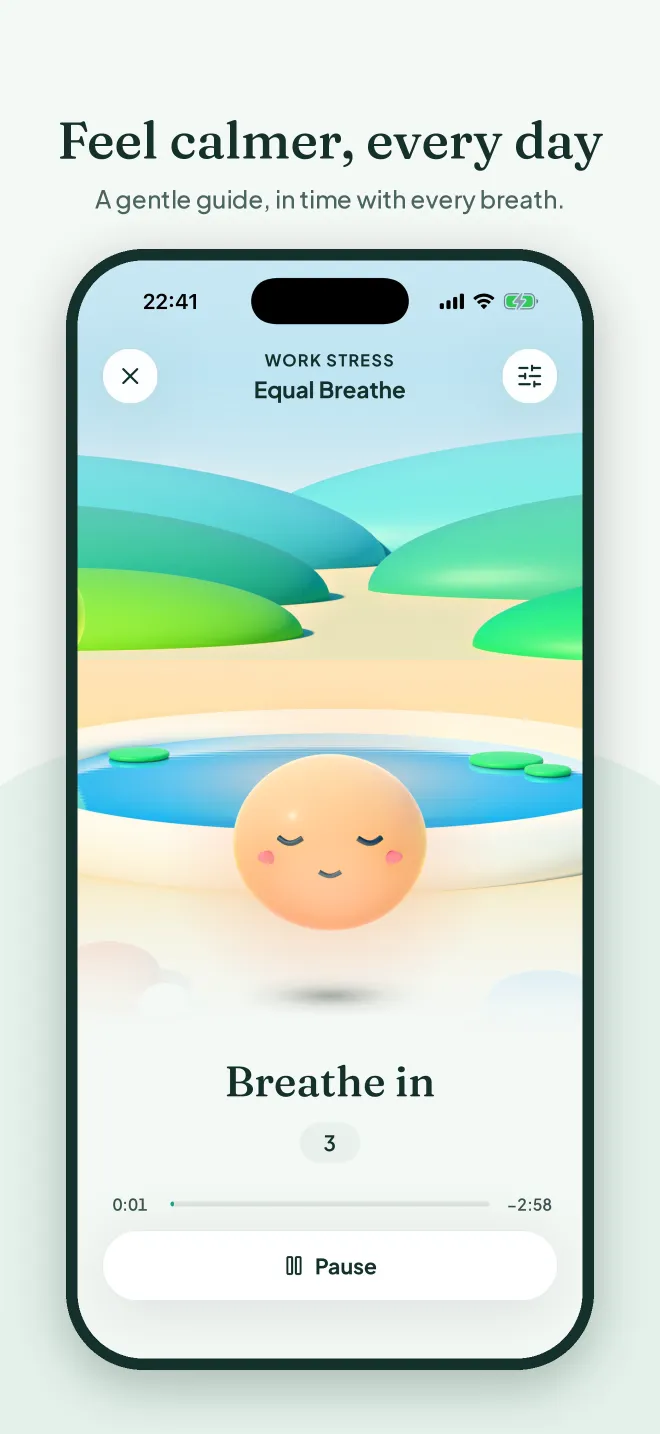
The 60-second breathing reset
- 1
Pause. Stop what you are doing. Put both feet on the floor and let your hands rest.
- 2
Long breath out. Start by breathing out slowly, as if you are fogging up a window.
- 3
In for 4. Breathe in gently through your nose for a count of four.
- 4
Out for 6 to 8. Breathe out through your nose or pursed lips for six to eight counts, letting your shoulders drop.
- 5
Five more times. Repeat for about a minute. Then take one normal breath and carry on.
Why a longer exhale calms you down
When you're stressed your breath gets quick and shallow. Deliberately slowing it, with the out-breath longer than the in-breath, is associated with more parasympathetic "rest and digest" activity (Zaccaro et al., 2018). In a month-long randomised study at Stanford, five minutes a day of exhale-focused breathing improved mood and reduced resting breathing rate more than mindfulness meditation did (Balban et al., 2023).
Pick the right quick breath for the moment
- Panicky or keyed up? Humming bee breath: hum softly on a long out-breath.
- Stressed at work? Box breathing: 4 in, 4 hold, 4 out, 4 hold.
- Hot and overwhelmed? Cooling breath: breathe in through closed teeth, out through the nose.
- Just need to land? Long-exhale breathing: 4 in, 8 out.
These are the five Quick Relief techniques in Swas: three-minute guided sessions you pick by how you feel ("Feeling panicky", "Work stress", "Overwhelm"), all free.
Make it automatic
A breath you've practised on calm days is much easier to use on hard ones. Ten minutes of Daily Practice a day, plus a quick reset when you need it, is the rhythm Swas is built around.
Frequently asked questions
What is the quickest way to calm down?
Slow your breathing and make the exhale longer than the inhale: in for 4, out for 6 to 8, for about a minute. It works anywhere, and nobody needs to know you are doing it.
What is a physiological sigh?
A physiological sigh is a double inhale through the nose followed by a long, slow exhale through the mouth. Repeated for several minutes it is called cyclic sighing, the practice that performed best in the 2023 Stanford study.
References
- Balban MY, Neri E, Kogon MM, et al. (2023). Brief structured respiration practices enhance mood and reduce physiological arousal. Cell Reports Medicine. doi:10.1016/j.xcrm.2022.100895
- Zaccaro A, Piarulli A, Laurino M, et al. (2018). How Breath-Control Can Change Your Life: A Systematic Review on Psycho-Physiological Correlates of Slow Breathing. Frontiers in Human Neuroscience. doi:10.3389/fnhum.2018.00353